

 |
| Wednesday's Fed decision will get the headlines this week. But the number that actually moves your equity just showed up in the fresh MRED numbers, and it isn't the federal funds rate. |
|
We've been building toward this one for a few weeks. Back in mid-July, the fresh export flagged something worth watching: destination towns in this corridor were appreciating two to three times faster than origin towns. That was a thesis at the time, a pattern worth confirming with a full year of data. As of this week's pull (7/26/2026, rolling 12-month, single-family detached), it's confirmed. |
| 1. The Corridor Gap, Town by Town |
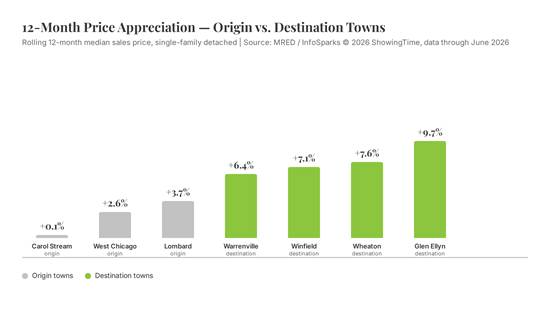
Over the last twelve months, the three origin towns in this corridor (Carol Stream, West Chicago, and Lombard), posted median price gains of 0.1%, 2.6%, and 3.7%. The four destination towns (Warrenville, Winfield, Wheaton, and Glen Ellyn) all posted 6.4%, 7.1%, 7.6%, and 9.7%. That's an average of roughly 2% for origin towns against roughly 7.7% for destination towns, close to a 3-to-1 spread, and it held up across every single town in each group, not just the strongest performer. |
 |
 |
|
Zoom into the corridor's most direct pairing and the pattern gets concrete. A year ago, the median West Chicago home sat $75,000 below the median Wheaton home. Today that gap is $100,000. It didn't jump all at once. it built steadily, month over month, while rates, headlines, and Fed speculation came and went. |
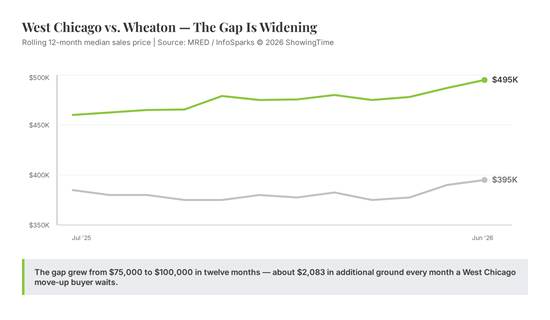 That's roughly $2,083 in additional ground every month a move-up buyer waits on the sidelines. Wheaton remains the tightest submarket in the corridor at 1.3 months of supply; West Chicago has actually loosened to 2.4 months, still tight by balanced-market standards, but the loosest it's been in this data set, and a big part of why the gap keeps widening rather than closing. |
This Week in DuPage |
|
| The Bottom Line |
The Fed will do whatever the Fed does on Wednesday. It won't change the fact that this corridor has been quietly sorting itself into winners and laggards for a full year now, and the data finally backs it up in every direction we can measure. If you're holding equity in an origin town and eyeing a destination town, the math says the trade gets more expensive the longer you wait, not because of Washington, but because of what's already happening two towns over. |
|
|
 |
